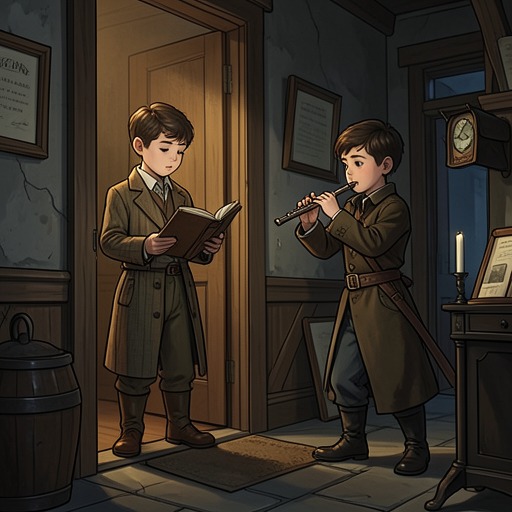
Pinocchio sells his primer to see a puppet show
The Adventures of PinocchioPinocchio sells his primer to see a puppet show in an impulsive choice that sets immediate pleasure against schooling and exposes the cost of Geppetto’s sacrifice. The sale turns a book bought through his father’s hardship into the price of admission, carrying Pinocchio from the road to school into a theater where he is welcomed by the Marionettes and soon faces Fire Eater’s attention.
The choice to follow the music
On his way to school, Pinocchio hears pipes and drums coming from a street leading to a village by the shore. The sounds interrupt his intended route and force a choice: continue to school or follow the music. He tells himself that school can wait until tomorrow, then runs toward the noise. The decision is not made under pressure from anyone else; he puts off his lesson because the spectacle seems more compelling in the moment.
The music leads him to a square crowded with people in front of a brightly painted wooden building. Pinocchio discovers that admission costs four pennies. His eagerness to see what is inside is strong enough to make him ask a boy for the money, although the boy cannot lend it. The small failed appeal sharpens the practical obstacle: curiosity alone will not get him into the theater, and he must find something to exchange for admission.
The book changes hands
Pinocchio hesitates before offering his A-B-C book. He first considers making another offer, but lacks the courage; at last he asks whether the boy will give him four pennies for it. The boy refuses, saying he does not buy things from other boys. A ragpicker nearby offers the required amount, and the exchange takes place immediately. The book that was meant to support Pinocchio’s education becomes the means of avoiding school and entering the show.
The transaction carries a consequence beyond Pinocchio’s own loss. Geppetto had sold his coat to buy the book for his son, and the narration places that sacrifice beside the sale: while Pinocchio trades away the primer, his father is at home in his shirt sleeves, shivering with cold. The contrast makes the value of the object tangible. It is not simply a school supply that Pinocchio no longer wants; it embodies the effort and deprivation Geppetto accepted for his child. Pinocchio’s exchange therefore makes his preference for immediate entertainment costly in a way he does not appear to consider at the moment of sale.
Welcome onstage, danger backstage
With the four pennies, Pinocchio enters the Marionette Theater. The performance is already under way, but the Marionettes recognize him as their brother and interrupt their act to celebrate his arrival. They lift him onto their shoulders and carry him around the stage in triumph. What began as an attempt to watch a show instead makes Pinocchio its center: the audience has come to see a performance, while the Marionettes turn their welcome into an unscheduled spectacle of their own.
The celebration changes abruptly when Fire Eater appears. His imposing form and threatening whip contrast with the Marionettes’ joyful, collective welcome. He has a long black beard reaching from his chin to his feet, a wide mouth, yellow teeth, and eyes described as glowing red coals; his whip is made from green snakes and black cats’ tails twisted together. At his arrival, the Marionettes tremble and the theater falls silent. The chapter’s framing makes clear that Pinocchio’s encounter with the theater’s director brings him close to losing his life. The sale thus opens a door to both recognition and danger: the same impulsive detour that brings him among figures who call him brother places him under the power of a frightening authority.
Significance in the story
The episode gives a concrete shape to the conflict between schooling and immediate distraction. Pinocchio does not merely miss a lesson; he relinquishes the very book Geppetto bought for him, and the four pennies purchase access to an entertainment that soon makes him part of the action. The sequence links his choice to its consequences without separating pleasure from risk: music draws him off course, the sale secures entry, the Marionettes’ affection transforms the show, and Fire Eater’s arrival turns celebration into peril.
The theater also introduces a recurring contrast between a performed body and control over one’s actions. Here Pinocchio is carried aloft by the Marionettes in a display they create, before Fire Eater’s presence imposes a more threatening form of authority. Later, Pinocchio’s body is again trained and publicly displayed, this time as a donkey performing for an audience. The episodes differ in circumstance, but both place him before spectators and make performance a visible consequence of who directs the action. In this first theater visit, the decisive reversal is that Pinocchio sells the book to watch others perform, only to become the center of the stage himself.